
By Jason Williams, Taxpayers Association of Oregon / OregonWatchdog.com
—
It was historic.
It blew everyone away.
A quarter million referendum signatures raised in just 38 days.
It stumped Governor Kotek, it dumbfounded lawmakers, it shocked the media, and it may have a gigantic impact on the 2026 Election.
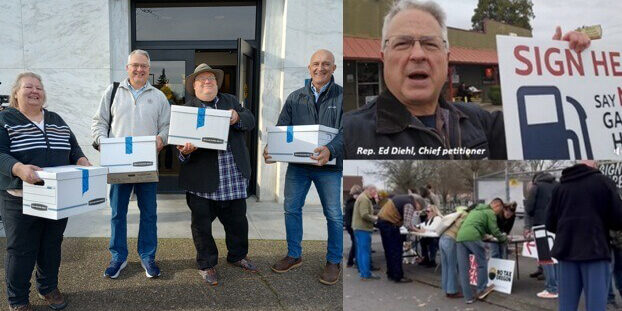
This is the inside story on how the campaign pulled off an against-the-odds miracle with their referendum petition to stop Kotek’s $4.3 billion gas tax by forcing it to the ballot for a public right to vote.
#1. They said it was impossible. At the start of the campaign, many top donors and businesses declined to help. They said it simply could not be done. We were barely funded. There was no money for paid signature gatherers. Yet the campaign did it anyway with mostly volunteers and won. The impossible was achieved. It is time to believe in Oregon again.
#2. Unity at the beginning. The Chief Petitioners for the campaign were Oregon State Senator Bruce Starr, State Representative Ed Diehl, and Jason Williams, Founder of the Taxpayers Association of Oregon. Having both a Senator and Representative sent a powerful message of Legislative unity right from day one of the campaign. Both chambers do not always talk to each other. Yet 2025 was different because both chambers worked together on many projects with then-Senate Republican Leader Daniel Bonham and then-House Republican Leader Christine Drazan. Senator Starr and Representative Diehl built on this working-together model and took it to the next level. Seeing both chambers work together in a rare show of unity did much to rally the extremely divided Republican factions in Oregon from the very beginning. This factor is more important than people think since Gallup this week revealed that people leaving political parties has reached record levels.
Chief Petitioner Senator Starr was a legacy statesman, having been involved in Oregon politics since the 1980s helped model unity for the campaign. Chief Petitioner Representative Diehl is a lawmaker who had a unique and strong bond with the public. Our in-house internet tools (OregonWatchdog and OregonCatalyst) cite his articles and floor speeches as the most clicked and re-posted of any Oregon elected official. Simply put, the data showed Rep. Diehl as the most effective political communicator among any elected official in Oregon, which helped super-size the referendum campaign from the start. Oregon has a new voice with Rep. Diehl, and it is going to open up new doors of opportunity for our movement — stay tuned. Lest there be too many politicians at the top, a third and final Chief Petitioner was added with Jason Williams and his Taxpayers Association of Oregon of 25 years, which provided a streetwise grassroots face to the campaign.
#3. Unrivaled grassroots unity. Once the Legislature approved the tax, everyone rallied behind an existing website called No Tax Oregon. The website was created earlier in the year by a newly formed organization called Oregon Freedom Coalition — an organization that everyone will hear a lot more about in the coming months. Political groups (Taxpayers Association of Oregon, Oregon Liberty Coalition, Oregon Freedom Coalition), political parties (Republican, Libertarian), and media voices (Lars Larson, Angela Todd, Rick Dancer) began sending everyone to the website in droves. By the time Governor Kotek finally signed the tax bill on November 13th, nearly 5,000 people had registered online to request a petition. To put that in perspective, on day one, we had enough people that, if only the people who registered online had circulated a petition, we could have nearly made the ballot if everyone had just filled out two petition sheets.
#4. Social media titans forever changed the face of Oregon media. Podcasters, YouTubers, and X influencers like Rick Dancer, Angela Todd’s PDX Real Media, Jeff Eager’s Oregon Roundup, David Medina, Oregon DOGE, Oregon Citizen, and OntheVirg! have amassed huge audience followings and spread the word like lightning. PDX Real and David Medina have national followings, having become national correspondents reporting live from the Oregon culture war zone. David Medina has 77,000 followers on X. PDX Real is a Fox News favorite. Jeff Eager is a full-blown investigative reporter who breaks all kinds of stories as if he were a one-man Statesman Journal. When Rick Dancer speaks on YouTube, thousands tune in. When these influencers above spoke about the gas tax referendum, we could see in real time people visiting the campaign website and clicking the button to request a petition. This is powerful. This is the face of new media in Oregon. It is quickly breaking new ground, empowering citizens, and is here to stay. Take, for instance, the national example of Charlie Kirk, who, by one measure, had a 94% recognition rate among young people. Before his death, Kirk became one of the most recognizable political figures in America by mastering his reach on TikTok and YouTube, reaching hundreds of millions. Many credit Charlie Kirk’s national mobilization as a key factor in the 2024 Presidential election. Oregonians need to rally behind our growing social media entrepreneurs with their views, Likes, posts, and emails.
#5. The Lars effect. As traditional newspapers decline (many have closed) in Oregon, the role of television news and radio has only increased online. Nothing compares to Lars Larson and his show, which is on 18 affiliate stations in the Northwest. Whenever I would speak on the Lars Larson program, it would generate comments from my non-political family and friends. A recent Taxpayers Association Foundation survey asked politically involved Oregonians where they get their local political news. Among early results, Lars Larson not only scored highly but was also #1 among respondents who had only one source of local political news. This is critically important. This is because radio reaches people like few other media sources. Radio plays at work, in the warehouse, in the office, and in the waiting room, where everyone hears it. The radio is in our car when we drive and in our house when we wash the dishes. Oregonians who are working on projects need to get on the Lars show – he is both our Rush Limbaugh and Joe Rogan. Lars Larson’s contribution to the campaign was immeasurable and incredible. Kudo also to Jeff Kropf’s Political Coffee radio program.
#6. The volunteer machine. Representative Ed Diehl and grassroots veteran Jodie Fleck devised a network to mobilize petitions. It created petition captains in every county and in every major city in Oregon. This helped centralize the flow of petitions and information. This helped reduce petition mistakes and eliminate duplication errors (like having two booths at the same farmers’ market on the same day). This network also pushed hard to have every petition leader train their people to properly petition, requiring them to complete online training courses. Petition errors are extremely problematic. Petition error rates can hit 40% in some cases. Every effort was made to reduce errors. During the waiting period, Jodie Fleck and Nick Stark of No Tax Oregon held valuable petition training webinars. The Taxpayers Association of Oregon mailed postcards to 10,000 potential petitioners, featuring a graphic guide to the dos and don’ts of collecting signatures. People saw an endless stream of how-to-petition articles on OregonWatchdog, OregonCatalyst, and Ed Diehl’s social media accounts. Nothing in all of recent Oregon political history had witnessed this level of safeguarding and preparation. The end result was low error rates. The first round of petition verification by the Oregon Elections Office yielded error rates of 2-3%. The system worked. This system was also extremely effective in getting petitions into people’s hands at record speed. For the people not reached by volunteers, there were tens of thousands of petitions mailed directly into people’s homes. Many non-political homes were targeted, helping to bring new people into the process. This is one way the campaign is changing the face of Oregon politics.
#7. The people behind the petition machine. The system worked because of the hard work of Representative Ed Diehl, Jodie Fleck, John Swanson, and Nick Stark. Rep. Diehl is a mechanical engineering graduate. He is Oregon’s version of Elon Musk (but without the money) as he zeroes down on a problem and then comes up with solutions that no one else considered. The success of the volunteer machine started with Rep. Diehl. Nick Stark is the Executive Director of Oregon Freedom Coalition, who helped make the No Tax Oregon website work like magic. Nick Stark is Oregon’s idea man, and you will be seeing more of him very soon. John Swanson is the Chief of Staff for Senator Starr and a fierce defender of taxpayers. He helped pull the dream team together and kept it together. He is now running for Polk County Commissioner. As for Jodie Fleck, she was a pure veteran of grassroots activism. She also completely dedicated her life to this campaign petition effort, working nearly 40 days straight, 12 hours a day, from her home. Her beloved husband cooked all the meals for a month, as this campaign was so demanding because our window to collect signatures was so short. Jodie was like a human sacrifice for this effort. Jodie was also famous for not budging and not backing down in the face of intense backlash (and at times cruelty) from people who disagreed with the process. Having worked with her, I can say she is one of the greatest achievers and patriots in our state, having changed the direction of Oregon for the better. Oregon owes her a lot of bouquets of thanks and gratitude from all of us.
#8. Clueless Kotek. While the petition team was doing everything correctly, our opponents were doing everything wrong. Oregon Governor Kotek forced lawmakers to cancel their Labor Day weekend plans with family to come to the State Capitol to pass her terrible tax bill, yet she herself didn’t bother to go to the Capitol to speak at the hearing for her own bill. Kotek was too busy vacationing on the coast to participate in the Session she forced others to attend. The Special Session was so bad that The Oregonian ran this quote: “Democrat lawmakers in Oregon began a special session Friday — and immediately failed spectacularly.” This quote was so damning and true that The Oregonian removed it 10 hours later.
Governor Kotek then delayed signing the bill as a tactic to cheat our petition effort of the time we had to gather signatures. This drew criticism from the mainstream media and even two letters from Democratic lawmakers begging her to stop the delay. Then Kotek still refused to sign the bill and instead went on a $200,000 junket trip to Asia at taxpayers’ expense. The Taxpayers Association of Oregon sent a copy of the gas tax bill to Japan and South Korea, asking our ambassadors there if they had seen our Governor vacationing, and to please forward the bill for her to sign. The embassies apparently did not see her, nor did anyone else, as we found no media coverage of her nearly two-week-long trip. Then, when Governor Kotek returned, she decided to secretly sign the bill on a Friday night, turning off her phone so no one would know until Monday morning. That was petty, foolish, and clueless. The whole year of negative stories on Kotek, combined with an oversized tax, drew people to our side. Union members often spoke to petitioners, expressing their anger over the gas tax and how people were being shafted in the process. Kotek tried to sell the public on ODOT budget scare tactics — but this time we had a secret weapon with Senator Bruce Starr who spent 30 years as Oregon’s transportation expert and who could easily dismantle her arguments before the media.
#9. Unity among a state of disunity. We continue to emphasize the importance of unity during the campaign because the state is painfully divided. There have been fierce civil wars erupting within the Republican, Libertarian, and Constitutional Parties. People have enacted litmus tests to exclude others based on political theories (as opposed to political beliefs). Even during the petition campaign, some would not turn in their petitions to their local petition captain because of political differences. The referendum petition state coordinator for the campaign, Jodie Fleck, said it best when she said, “We have in Oregon lost the art of agreeing to disagree”. The more Oregon’s tax revolt can work together across party and political lines, the more power we have. The power of unity is not conformity — it is when people who do not agree decide to work together on what they agree upon. Unity is our most powerful tool. Even in the campaign there were disagreements and differences but it got worked out quickly. Interestingly, at the start of 2025, long before there was a gas tax, Rep. Diehl was building the Oregon Freedom Coalition and was seeking the web domain name OregonFreedom.com which just happened to be in reserve by the Taxpayers Association of Oregon and used for past tax campaigns. The Taxpayers Association freely passed it on to Freedom Coalition and pledged to help anyway they could because it is not about competition but coalition building. Who knew then that seven months later, Rep. Diehl would return the favor a hundred times over with the campaign effort. Welcoming Freedom Coalition as a partner was not how people welcomed the Taxpayers Association of Oregon 27 years ago as other conservative groups worked to block and undermine their involvement. Remember, unity works. If we can do it, you can do it.
Bonus reasons – a changing Oregon. A wave of change is in the air in Oregon. It is coming from different directions. First, Oregon is rapidly falling behind as other states move forward in prosperity and progress. Oregonians can feel the pain of economic trouble like never before since the 2008 Great Recession. The data shows that the people who are moving out of Oregon are of higher income. They are moving because they can, while those left behind are trapped by the higher taxes — that are raised even higher to pay for the lost revenue from the people leaving. In Portland, there are many famous office buildings that are selling at 80% of their value. Everyone feels the pain.
When taxes begin to bite even harder, the more activated voters become. We feel that activation right now. This is why even Governor Kotek has spoken out against new taxes in Portland and against a local Salem tax measure in 2024 – but not against her own state taxes, of course. Governor Kotek sees the poll numbers and knows there is tax fatigue right now. This is why one of Governor Kotek’s top campaign issues in her 2026 re-election campaign is her touting that she stopped tolling. This is not true, by the way.
When Charlie Kirk was shot, it really hit Oregonians hard. Spontaneous candlelight vigils began sprouting up across the state. People began sending photos to our office to post on Oregon Catalyst. People said they have never experienced anything like it. Huge crowds showed up beyond capacity, with people spilling onto the streets, young people in large numbers, and an overwhelming sense of warmth and harmony that they seldom see at events. Some vigils were so successful that they kept hosting them. In Newport, they prayed for Kirk’s shooter (this was before the funeral) while rude people driving by screamed vile obscenities at the women and children who were mourning. To me, that was a perfect symbol of the cultural battle we are in and the enduring goodness of our beliefs. An astonishing one thousand people showed up for a Charlie Kirk vigil in Eugene. It was so overwhelming that a local Anarchist website warned their members that such conservative outpourings were winning the hearts of the public — and must be stopped! At some level, something changed in Oregon after Kirk’s shootings, where Oregonians were tired of being silent and tired of being afraid, and felt compelled to show up.
At the exact same time, there were other signs of change in Oregon. As rioters protested outside the Portland ICE building, one young Oregon mom decided to show up to livestream the chaos online. The rioters cruelly harassed her. A few young Oregon students saw what was happening live on the internet and simply could not stand back and watch this young woman being preyed upon by a mob of criminal rioters. So, they grabbed an American flag and drove right to the riot protest in real time. They came to her defense and waved American flags. Other people joined in, and suddenly a counter-protest movement was born. Because the Taxpayers Association of Oregon has monitored the Portland riots for five years, we can attest that we have rarely seen anything like this from unorganized citizens standing up to hostile Portland rioters. From this, a steady stream of counter-protestors emerged. It spoiled the atmosphere of the rioters. This was another small sign that Oregonians were tired of the chaos and wanted to speak their minds. Things were changing in Oregon in 2025.
This article is my attempt to inspire you that we can do the impossible. There is real power in unity and coalition building. This little miracle happened because we were blessed by an amazing team that gave everything they had to make it happen.
Oregon needs to hear this inspiring and insightful message. Please email it, Like it, post it, print it and share it.